
What is a KPI?
KPIs help you understand what’s working – and what needs improvement.
KPIs are concrete numbers that show progress, quality, or profitability.
On this page, we’ll explain everything you need to know about KPIs.
What Is a KPI?
KPI stands for Key Performance Indicators.
You might also hear them called:
- performance metrics,
- efficiency indicators,
- or success measures.
They’re specific, measurable values that help you understand whether your business is moving in the right direction.
KPIs show whether goals are being met, processes are running smoothly, and where potential issues may be hiding.
See How We’ll Help You Become the KPI Expert in Your Company
✅ Example from a Manufacturing Company:
High defect rates = financial losses
In manufacturing, a large share of losses comes from producing defective items.
That means wasted materials, lost labor time, and extra costs for rework or scrapping.
To keep this under control, it’s smart to introduce a KPI like:
Daily Defect Rate
Goal: Less than 2% defective products by the end of each shift
Why does it work?
This KPI provides a clear, measurable signal that helps identify problems early, monitor quality in real time, and take corrective action before losses grow.
- Managers can instantly see if production quality drops.
- It’s easy to quickly identify the cause – for example:
- a new operator, a machine issue, or a lower-quality batch of materials.
- The company can react immediately, instead of discovering the problem a week or a month later.

The Result?
Reducing defects = saving thousands of dollars each month.
These are concrete numbers that show whether the company is moving in the right direction.
They reveal if goals are being met, if processes are running smoothly, and where problems are starting to appear.
❌ What KPIs Are NOT:
Many business owners think that KPIs are:
– any chart in Excel,
– any number from a system,
– or just some data that kind of shows what’s going on.
That’s a mistake.
👉 A KPI Is a Measure of a Goal – Not Just Any Data
A real KPI must be:
- tied to a specific goal (e.g. quality, profitability, time),
- measured regularly,
- easy to interpret and actionable.
🧩 Summary
KPIs are carefully selected numbers that help you manage, evaluate, and improve your company’s performance.
It’s not about creating reports just because — it’s about gaining insights that lead to real decisions.
KPI – Why Measure at All?
Companies that don’t measure are managing in the dark.
KPIs Deliver Real Benefits:
Better Decisions
🎯 You rely on data, not gut feeling
Progress Tracking
✅ You know whether you’re moving toward your goals
Faster Problem Detection
🚨 You don’t have to wait until the end of the month to spot issues
Team and Process Performance Evaluation
📊 You can clearly see who and what is driving results

KPI – What Do They Look Like in Practice?
Real KPI Examples from Manufacturing, Service, and Retail Companies
KPIs Aren’t Abstract Concepts – They’re Concrete Numbers You Can Apply in Any Business.
Below are the three most common scenarios we encounter when working with companies.
🔧 Manufacturing
KPI: Defect Rate (%)
Shows the percentage of produced items that turned out to be defective.
Helps maintain quality control and reduce material and time losses.
🕒 Services
KPI: Response Time to Customer Inquiries
Measures the time between a customer reaching out and receiving the first reply.
Directly impacts service quality and how customers perceive your business.
💼 Sales
KPI: Monthly Sales per Salesperson
Helps set realistic sales targets and identify top performers as well as team members who may need support.
These three KPIs can be implemented in any company — no complex systems or years of analysis required.
All it takes is consistent data collection and a habit of drawing insights from it.
Common Mistakes When Implementing KPIs
Why do so many companies introduce KPIs… and see no real change?
Choosing a few metrics isn’t enough.
In reality, many businesses make the same mistakes that turn KPIs into just another spreadsheet — instead of a real management tool.
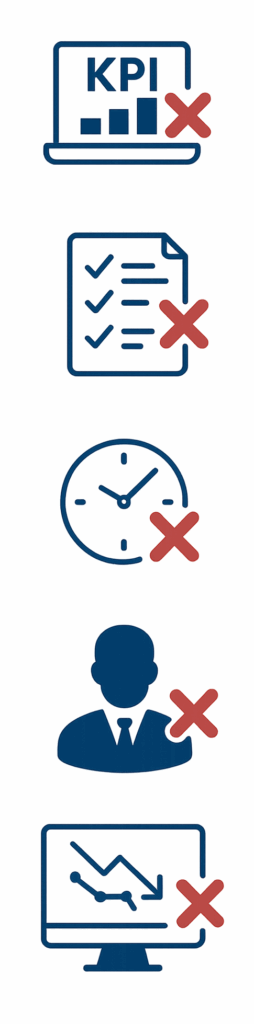
❌ Top 5 KPI Implementation Mistakes
1. Choosing KPIs at random or copying them from the internet
Without linking KPIs to business goals, they’re useless. If you don’t know why you’re measuring something, you won’t know what to do with the results.
2. Starting with too many KPIs
Instead of focusing on a few key metrics, some companies track a dozen indicators — which leads to confusion and inaction.
3. No consistent data collection
Even the best KPI is worthless if data isn’t collected regularly… or at all.
4. No KPI ownership
No one feels responsible for the results. No one analyzes them. No one takes action.
5. No interpretation or follow-up
The company sees the numbers dropping but does nothing. KPIs become “pretty numbers” with no real impact.
🧭 How to Avoid These Mistakes
You need a thoughtful process that:
- aligns KPIs with your business goals,
- simplifies the implementation,
- shows you what to measure first,
- and helps you roll it out without chaos or frustration.
Want KPIs That Actually Work?
Stop Guessing – Start with a Ready-to-Use Plan
-
FIRST KPI – STARTER
$177.00 z VAT -

KPI Implementation Checklist
$29.70 z VAT
Implementing KPIs in your company doesn’t have to be hard, messy, or time-consuming.
But there’s one condition: you need a clear plan to do it right.
